
How Do You Verify the Purity of 4-Bromo Aniline Before Ordering?
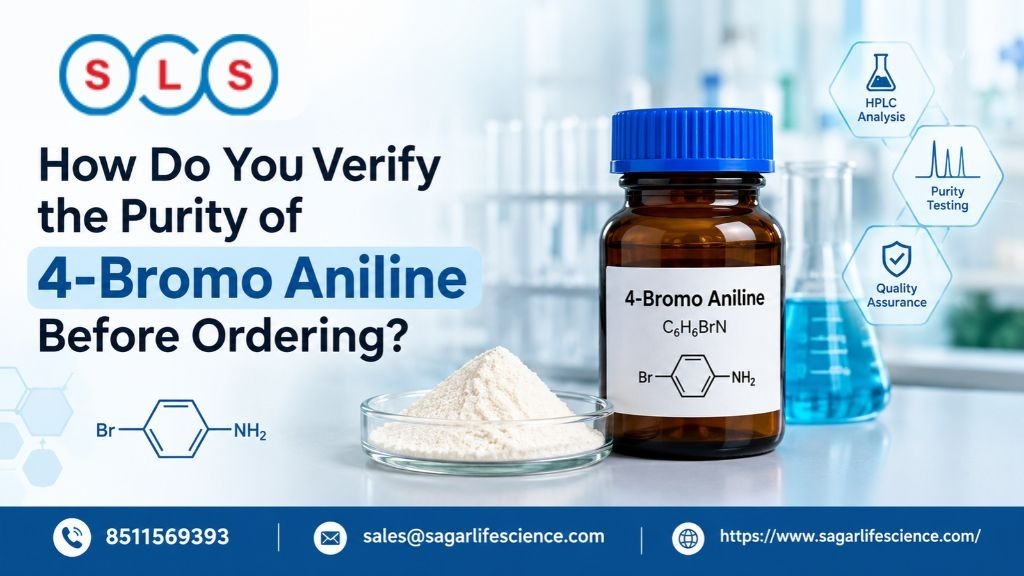
To verify the purity of 4-Bromo Aniline, review the batch-specific Certificate of Analysis (COA), the reported test method and result, the written acceptance criteria, and the supplier's documentation, then check all of it against the grade you actually need. This is the buyer's side of 4-Bromoaniline purity testing: you are reading professionally generated evidence, not running the tests yourself. A purity percentage on a product page is only one input. You also need matching identifiers, a defined grade, a clear analytical method, and traceable batch records. This guide covers COA verification, analytical testing, product specifications, and supplier evaluation before you place an order.
What Is 4-Bromo Aniline and Why Does Its Purity Matter?
4-Bromoaniline is an aromatic amine used as a building block in chemical synthesis and as an intermediate in a range of chemical applications. Not every grade suits every application, so identity and specification come before price.
Verified Identifiers (as Published in Supplier Listings)
Buyers verify identity and purity for four fundamental reasons:
- To confirm the supplied material matches the requested specification.
- To reduce the risk of receiving material that misses the agreed requirements.
- To support traceability and internal quality records.
- To confirm suitability for the intended process.
These checks apply whether the material is bought for industrial, research, or manufacturing use. They do not replace your own internal quality release procedures.
5 Important Checks Before Ordering 4-Bromo Aniline
Use this structured checklist whenever your procurement team reviews a quotation or vendor dossier:
The product name, CAS number (106-40-1), formula, and other identifiers should match across the quotation, specification sheet, COA, and product label. Similar names or abbreviations are not a substitute for checking the actual chemical identity.
Ask the supplier for the applicable grade and written acceptance criteria. The right purity level depends on your application and specification. The highest advertised percentage is not automatically the correct purchasing criterion.
Ask for a COA that corresponds to the specific batch intended for supply. It should carry identifiable batch information, production dates, and relevant test results rather than generic catalog specs.
Check which analytical methods were used, what each one measured, and whether the analytical evidence supports the quality claim being made by the exporter or manufacturer.
Review the supplier's business details, technical responsiveness, and product information. A dependable supplier should be able to clarify documentation questions before you order, not after.
How to Read a Certificate of Analysis for 4-Bromo Aniline
A Certificate of Analysis (COA) documents specified test results for a particular product batch. Where applicable, examine each of these key fields:
- Product name and CAS number: Confirms correct chemical entity (CAS 106-40-1).
- Batch or lot number: Must match shipment labels, drum marks, and invoices.
- Report or test date: Verifies testing recency and shelf-life validity.
- Test method: Identifies analytical technique (e.g., GC, IR, titration).
- Reported assay or purity result: The quantified numerical value obtained.
- Acceptance criteria or specification limits: The allowable benchmark window.
- Other relevant analytical results: Moisture, melting range, physical appearance.
- Issuing laboratory or responsible organization: The authorized testing body.
- Authorization or verification details: Approving sign-off from QA/QC management.
Match the COA's batch number to your intended shipment, then check whether the reported results meet the agreed purchase specification. A generic specification sheet shows what the supplier says the product should meet. It is not a test report for a specific batch. If information is missing, inconsistent, or unclear, ask the supplier to explain it before you approve the order.
Key Takeaway on COA Interpretation
A COA is evidence about the specific tests it reports. It does not automatically establish every aspect of a product's quality or suitability. Always read the reporting basis and ensure the batch number corresponds directly to the lot you are purchasing.
Which Analytical Tests Can Help Verify 4-Bromoaniline Purity?
This is the technical core of 4-Bromoaniline purity testing: each test answers a different question, and none answers all of them in isolation.
Gas Chromatography (GC)
Gas chromatography (GC) separates the components of a sample and can be used to assess chromatographic purity or assay when the method suits the material. When reading a GC result, check the reported value and its basis, the method used, the specification it is judged against, and whether the report identifies the sample or batch. A chromatographic area percentage and another assay calculation are not necessarily interchangeable. Interpret the number according to the method and specification provided.
Infrared Spectroscopy (IR)
Infrared (IR) spectroscopy compares characteristic spectral features with expected information or a suitable reference. It supports chemical identity. An identity result is not a quantitative purity measurement.
Melting-Point Range
A melting-point result can serve as an additional identification or quality check. A result inside the specified range supports consistency with the expected material, but it cannot independently prove chemical purity.
Use the Results Together
Evaluate identity evidence, purity or assay results, the relevant specification, and batch traceability as a set. No single test is sufficient for every quality requirement, and testing should suit the material, intended use, and applicable specification.
| Check | Main Purpose | Important Limitation |
|---|---|---|
| GC | Assesses chromatographic purity or assay when the method is suitable. | The result depends on the method and reporting basis. |
| IR spectroscopy | Supports chemical identity verification. | It is not automatically a quantitative purity result. |
| Melting-point range | Provides an additional physical-property check. | It does not independently establish chemical purity. |
| Batch-specific COA | Records results for specified tests on an identified batch. | It does not guarantee every possible quality attribute. |
What Purity Percentage Should You Look For?
The appropriate specification depends on the grade you need and your application. Published listings show why no single threshold applies.
Merck's GR for analysis listing reports purity by GC of at least 99% (area/area), an IR identity test, and a melting point of 62–64 °C. The page currently marks that item as discontinued, so treat it as an example of how specifications are written, not as a purchase option. Tokyo Chemical Industry's (TCI) 4-Bromoaniline listing states a GC purity of at least 99.0%, a separate nonaqueous titration purity of at least 99.0%, and a melting point of 63.0 to 67.0 °C.
The headline numbers look similar, yet the methods, additional tests, and ranges differ. To compare like with like:
- Identify the required grade before requesting a quotation.
- Confirm the agreed purity or assay in writing.
- Check which analytical method supports the reported result.
- Review the other acceptance criteria, not only the headline percentage.
- Confirm the documentation meets your internal quality requirements.
How to Choose an Exporter of 4-Bromo Aniline in India
If your search is "exporter of 4-Bromo Aniline India," the same evidence-first approach applies to domestic and international buyers. Look for:
- Clear product specifications and traceable batch documentation.
- Verifiable business and contact information.
- Transparent quotation, invoicing, and order terms.
- Clear communication about availability and dispatch.
- Appropriate packaging and handling information.
- Relevant export documentation and willingness to clarify destination-specific requirements.
- A defined process for resolving differences between the order and the delivered material.
Roles differ. A manufacturer makes the product. A distributor resells material from manufacturers. An exporter handles the international sale and may supply material made by another organization. Establish who manufactures the material, who performs the testing, and who is responsible for providing the documents. Do not assume an exporter is the manufacturer, or that every exporter holds the same manufacturing certification. Buyers evaluating Sagar Life Science can ask these same questions and request the documents below.
| Document | What the Buyer Should Verify |
|---|---|
| Product specification sheet | Product identity, grade, and agreed acceptance criteria. |
| Batch-specific COA | Batch identifier, test results, methods, and reported specifications. |
| SDS (Safety Data Sheet) | Hazards, safe handling, storage, and relevant emergency guidance. |
| Quotation | Product details, quantity, price, and commercial terms. |
| Invoice and order confirmation | Consistency with the agreed product, quantities, and transaction. |
| Export documents (where applicable) | Documents required for the specific transaction and customs destination. |
What Makes a Trusted Pharmaceutical Intermediates Exporter?
A trusted pharmaceutical intermediates exporter earns that description through verifiable evidence, not marketing language. Assess:
- Accurate product information and verified CAS numbers.
- Traceable quality documentation and responsive technical staff.
- Clear communication about specifications and limitations.
- Transparent commercial terms without hidden surcharges.
- Appropriate safety and handling documentation.
- Reliable order fulfillment and discrepancy-resolution processes.
- Export documentation suited to the product and destination country.
Safety and handling documents deserve a real read. Different listings describe the same CAS number with varying signal words and hazard statements, and major suppliers note light and air sensitivity with strict storage recommendations. Always review and follow the SDS supplied for your specific shipment.
Certification and regulatory requirements depend on the activity, product classification, destination, and applicable local regulations. No single document proves compliance in every market, and not every intermediate needs the same certification. The same test applies to any company, including Sagar Life Science: document your requirements and resolve open questions before approving the purchase.
Red Flags to Watch for Before Placing an Order
Being proactive about quality safeguards prevents costly shipment rejections. Watch out for these common warning signs:
Common Procurement Warning Signs
- The product identity or CAS number is missing or inconsistent across paperwork.
- The supplier cannot explain the stated purity result or test basis.
- The COA has no clear link or matching lot number to the intended batch.
- Reported test results do not match the agreed specification limits.
- Broad quality or certification claims are made without verifiable documentation.
- Technical questions receive vague, evasive, or contradictory answers.
- Invoices, drum labels, and test reports contain conflicting batch numbers.
- Packaging, handling, or transport arrangements are not explained when relevant.
A warning sign does not necessarily prove a supplier is unreliable. Unresolved inconsistencies, however, should always be thoroughly investigated before you proceed with payment or shipment release.
Final Checklist Before Ordering 4-Bromo Aniline
Pre-Order Procurement Checklist
- Confirm product chemical identity & CAS number (106-40-1)
- Define the required grade and written specifications
- Review a batch-specific Certificate of Analysis (COA)
- Check the analytical method and reported results
- Confirm reported results meet agreed acceptance criteria
- Verify supplier, manufacturer, and exporter details
- Review applicable safety, storage, packaging & shipping details
- Confirm invoice, payment, and delivery logistics terms
- Resolve any open discrepancies before approving the order
Frequently Asked Questions
Conclusion
Checking product identity, an appropriate purity specification, analytical evidence, a batch-specific COA, and supplier credibility before ordering protects both quality and timelines. Treat 4-Bromoaniline purity testing results as evidence to interpret against your own requirements, not as a guarantee.
Before placing your order, confirm the required 4-Bromoaniline specification and review the relevant quality documentation. Contact Sagar Life Science to inquire about applicable product details, availability, and commercial requirements.
Need dependable technical specifications or commercial supply for 4-Bromo Aniline? View our 4-Bromo Aniline product page or contact our sales engineering team today for customized lot documentation and quotations.